

With a trackable engagement platform, Curated Clinical CEO Allison Mathews believes the brainstorming process for community-based health intervention solutions can become much more efficient and effective.
Mathews, a former adjunct assistant professor in health behavior at the University of North Carolina’s Gillings School of Global Public Health and CEO and founder of Community Expert Solutions, has spent over a decade building community-based solutions to public health issues and supporting clinical research.

She and her partners have worked in the United States, China, South Africa and Nigeria, always with a focus on improving underserved communities’ ability to influence how clinical trials are conducted.
A primary mechanism used in this work is crowdsourcing, which Mathews described in its straightforward form as “posing a problem to the public and then asking them to contribute their ideas or solutions to solve that problem.”
To offer a few examples, questions asked during a crowdsourcing process might concern what would make clinical trials feel safer; what messaging potential subjects would trust; or what would help a given family say yes to a trial.
Particularly for communities typically underrepresented in the decision-making process for how clinical trials and health intervention research initiatives are conducted, crowdsourcing can help bolster the level of engagement in important scientific work.
“It actually has been shown to be just as effective, if not more effective, than consulting with a small group of experts, and then you also get… more diversity of ideas and solutions in a more cost-efficient and time-efficient manner,” Mathews said.
Per her LinkedIn, Mathews used crowdsourcing platforms and mobile applications through Community Expert Solutions to reach more than 400,000 people. According to Mathews, crowdsourcing has led to around 200 community-driven solutions—such as a scavenger hunt in a grocery store to help people waiting for their HIV tests keep their minds occupied and encourage more openness to HIV testing.
Before launching Curated Clinical in Clemmons, North Carolina in 2025, most of Mathews’ crowdsourcing was conducted in person, whether that meant going to parades, barbershops or football games and talking to people one-on-one. Mathews and her research partners also organized crowdsourcing contests that encouraged people in person and on social media to submit ideas, art and other answers to relevant health questions affecting them and their peers.
Providing a hub
It was based in part on these experiences that Mathews realized she could build a platform to support and enhance the practice.
“I decided to move all of that experience and intellectual property into a platform that would allow me to facilitate crowdsourcing contests with clients like pharma companies and community-based organizations, kind of bridging the gap through this platform and allowing the community to have more of a direct say in how research is shaped and done in their communities,” Mathews said.
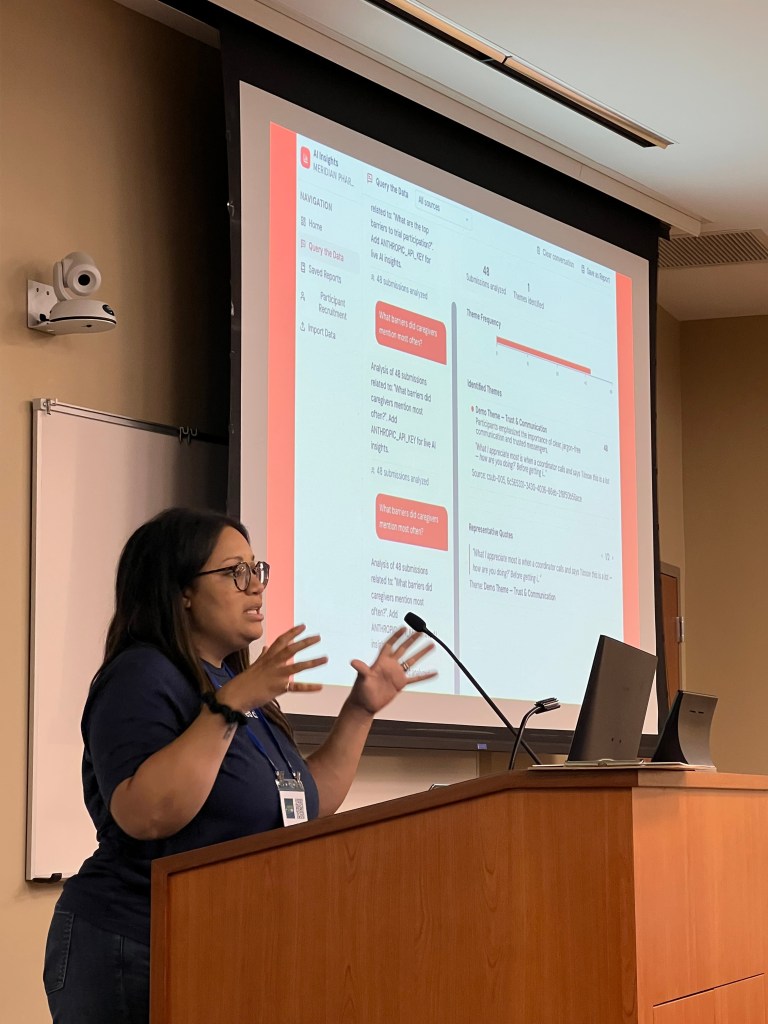
Beyond serving as a general hub, the Curated Clinical platform is equipped with an LLM that enables the system to analyze community members’ submissions across contests and programs, create themes, generate recommendations that integrate responses and develop campaigns.
Companies looking for participants for their clinical trials can also use the platform and the organized survey responses and data to tailor recruiting messaging to attract candidates.
Mathews said participants can take part in multiple contests and surveys so their data will grow within the platform. The data will help train Curated Clinical’s model to become more knowledgeable about how to build trust around clinical trials, though the surveys could be used for “any topic.”
According to Curated Clinical’s website, its platform operates under Institutional Review Board oversight (which focuses on the ethical conduct of research) and complies with HIPAA regulations. Users can access, correct or delete data submitted, and the platform will not share any information that users do not explicitly allow to be used.
Although other comparable survey platforms, such as Acclinate, provide a forum for people to share their health struggles and needs, Mathews said Curated Clinical differentiates itself by focusing on building solutions. She also described the startup as a “business-generating mechanism,” because community members have a direct space to share innovative solutions to health disparities and receive support to turn them those solutions into reality.
“It is important to develop ideas and solutions that solve real-world problems, and I think that’s what we’re doing here,” Mathews said.
QUICK BITS
Startup: Curated Clinical
Founder: Allison Mathews Allen
Founded: 2025
Team size: 5
Location: Winston-Salem
Website: curatedclinical.com
Funding: Bootstrapped
Mathews emphasized that Curated Clinical comes from over a decade of work around the world, and the key is to harness the connections built in that time to create something scalable globally. Potential clients include pharmaceutical companies, clinical research organizations and community-based organizations.
Curated Clinical offers tiered, subscription-based licenses. They include a community-organization level that focuses on the “functionality of the crowdsourcing contest,” as well as opportunities for larger companies to use Curated Clinical’s database to recruit participants into their clinical trials.
Curated Clinical has already signed with Syneos, a global clinical development company with headquarters in Morrisville, North Carolina, and Black Farmers’ Market, a North Carolina-based community organization focused on self-sustainability through fresh produce. The company will conduct a pilot in November 2026.
For communities interested in using Curated Clinical’s, Mathews said that the platform is built to “create a mechanism for a community to grow and nurture those ideas they may have just sitting around the kitchen table.”
