
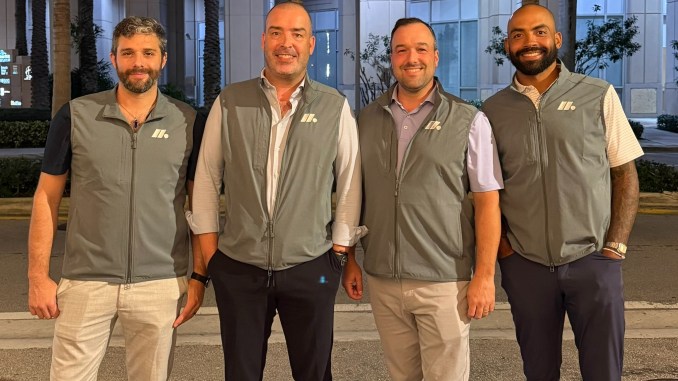
GrepBeat last wrote about Meridian Performance Systems in May of 2025, when it was implementing advanced computer vision technology primarily to enhance training for golf putting. Today, Meridian is an Charlotte-based startup using that same foundation of applied computer vision to provide the “perception layer” for the physical world.
For this piece, we caught up with Founder and CEO Josh Kohn to learn more about him, how Meridian has found its market, and what’s next as they continue to seek and capitalize on applications with significant long-term potential.
GrepBeat: Before we get started, for readers who may not be familiar, what’s the elevator pitch for Meridian?
Josh Kohn: Meridian is an applied computer vision company building the perception layer for the physical world. A huge share of the economy still depends on people doing manual, repetitive, and sometimes dangerous work, while more attention lately has focused on digital knowledge work. We’re closing that gap.
Today, that shows up in commercial real estate: A 20-minute on-site scan can replace weeks of manual property measurement with a digital record, without disrupting tenants. That’s our wedge into a much broader platform opportunity.
GB: When we got in touch, we asked you to look back on your last feature at GrepBeat, from early 2025. At that time, you were primarily applying computer vision solutions to golf putting training. What new markets or applications have you explored since?
Kohn: Golf was a great proving ground for the technology. We built something we’re really proud of, and it demonstrated the core capabilities well, but it wasn’t a venture-scale business by itself.
Since then, we’ve explored manufacturing, crowd management, professional sports, and a number of other applications. The common thread was that people could immediately see what the technology might enable. But commercial real estate was where we found the strongest and most immediate pull.
GB: Is that the market you’re most focused on now?
Kohn: Commercial real estate is absolutely our focus for the foreseeable future.

CRE teams spend $0.25 to $3.00 a square foot and significant time on consultant-based manual survey and measurement workflows, and the outputs are often static PDFs. We capture the data in about 20 minutes on site, with no tenant disruption, and the CRE teams get a digital record that’s ready to use immediately instead of a document someone has to read and re-key.
We’ve built and shipped a CRE measurement product, have an enterprise design partner/customer, and are in active conversations with the market. That is where we’re focused.
GB: How has your team grown or evolved since we last spoke?
Kohn: The biggest change is that my Co-Founder, Matthias Farley, joined after the last GrepBeat piece. He spent eight years in the NFL, and a striking number of former players end up in commercial real estate after their playing careers. That network has turned into real meetings with the exact buyers we’re trying to reach, faster than a cold outbound team ever could.
More broadly, we’ve gotten much clearer on how we work together and where each of us creates leverage, especially now that we’re focused on a very specific customer problem rather than several at once.
GB: What milestones or accomplishments are you most proud of?
Kohn: I’m proud of how quickly we moved from an initial conversation to being on site doing 3D scanning in about 30 days.
That was possible because we could draw on experience from prior projects, move quickly without cutting corners, and work closely with the customer. That same partner has since come back and expanded the engagement before we’d even finished delivering the first one. Now the work is refining the product, improving the workflows, and continuing to earn the right to scale.
GB: You’ve been on the scene for a little while now. People may know you as a founder, but perhaps less so as a human being. Tell us something we don’t know about you that has nothing to do with your life as a founder.
Kohn: I’m a veteran, and that experience has influenced a lot of how I think about responsibility, service, and what matters when things get difficult.
Because of that experience I am actively involved with a great non-profit, Veteran’s Bridge Home, and was able to directly support the Afghan resettlement efforts after the fall of Kabul. I actually got to represent VBH at the Whitehouse to discuss our efforts.
GB: What partners or organizations (service providers, advisors, investors, if any) have been most helpful to you?
Kohn: First and foremost, my wife and my two co-founders. I consider them to be my better 3/4ths.
She has been incredibly supportive throughout the founding journey, which is absolutely an act of faith.
Cody’s technical skill, Matthias’ relationships and perspective, and the way we challenge one another have been foundational. Together, the three of us are exponentially greater than the sum of our parts.
Outside the company, we have a strategic advisor, Daan Bemelmans, in the Netherlands, who is a near-daily sounding board. He pushes us to defend our thinking, asks hard questions, and helps us stay honest.
GB: What is your next, biggest challenge?
Kohn: Continuing to say no.
The technology has applications in a lot of places, and early on we explored many of them. We’ve since built a framework around market urgency, access to the buyer, problem clarity, technical fit, and opportunity scale. We score every opportunity against those five criteria, and only pursue the ones that clear a real bar.
The challenge is holding ourselves accountable to that discipline, turning down opportunities that may have real value today, but do not enough that compounds into the business we’re building.
GB: If you could go back in time to speak to yourself on the day you founded your startup, what advice would you give your younger self?
Kohn: I’m not sure I would have accepted the advice without living through the experiences that gave it context. I could have told myself it was not going to be golf forever, but pursuing golf led to relationships, lessons, and discoveries that helped get us here. I try not to spend much time thinking about what I would have done differently.
Make survivable mistakes, and keep going.
GB: People ask founders about their startups nonstop…. Is there anything about Meridian that you don’t get asked but that you’d like to speak to?
Kohn: I’m fortunate that the nature of the technology opens up a lot of interesting conversations. The challenge is not getting people to imagine what could be possible, it’s helping them focus on what we can do for them right now.
That is where we are as a company: taking something with broad potential and applying it with real discipline to a specific, urgent problem in commercial real estate.
GB: Finally, you finish a long, grueling day of starting up. You’re hungry and/or thirsty. Where in Charlotte are you headed?
Kohn: Home is the honest answer. But if we’re going out, Chapter Six.
